
Choosing the Right Commercial Fencing Solution
A growing business park off the Dallas North Tollway calls Fence Pros of Texas. One building houses a healthcare office, another a logistics warehouse, and a third a tech startup. Each needs a fence—but each needs something very different.
That’s commercial fencing in Plano in a nutshell. You’re balancing security, appearance, local codes, and budget in a market where property values and liability risks are high. According to the FBI, over 60% of burglary offenses involve non-residential properties, and commercial insurance carriers are increasingly factoring perimeter security into premiums. A poorly chosen fence can leave you exposed—legally, financially, and physically.
This guide walks you through how to choose the right commercial fencing solution for your property in and around Plano, TX. You’ll see how different materials perform, what local businesses are actually installing, and how to think about security, privacy, and long-term maintenance—not just the upfront price tag.
Key Insight: The “right” commercial fence is a security system, branding element, and long-term asset rolled into one—and it has to be matched to your specific property, risks, and operations.
Start With Purpose: What Your Fence Really Needs to Do
Before you compare fence styles, you need to be clear on the job your fence has to perform. Most commercial projects in Plano fall into a mix of these goals:
- Security and access control
- Privacy and screening
- Safety and liability reduction
- Aesthetics and branding
- Compliance with city codes, HOA rules, or industry standards
A logistics company off US-75, for example, came to us after a series of after-hours trespassing incidents. Their main priority was security—they needed a system that would deter climbing, integrate with cameras, and control vehicle access. Decorative touches were secondary.
Contrast that with a medical office near Legacy West. They wanted a fence that provided privacy for patients in an outdoor waiting area, fit the upscale look of surrounding businesses, and met ADA and local code requirements. For them, aesthetics and patient experience were just as important as security.
“Every commercial fence project starts with a risk and use analysis, not a material catalog.” — Senior Project Manager, Fence Pros of Texas
Ask yourself:
- Are you trying to keep people out, keep people in, or just define a boundary?
- Do you need full privacy or just a visual barrier?
- Will vehicles, forklifts, or delivery trucks interact with the fence daily?
- Is this a customer-facing area or strictly operational?
- Do you need integration with gates or Security Fence Installation systems?
Once your goals are clear, you can start matching them to the right fence types and features.
Comparing Common Commercial Fence Materials in Plano
Different materials bring different strengths, costs, and maintenance needs. Here’s how the most common commercial options stack up for North Texas properties.
Popular Materials for Commercial Properties
- Chain Link Fences
- Wrought Iron Fences and steel ornamental
- Aluminum Fences
- Corrugated Metal Fences and other Metal Fence Installation options
- Vinyl Fences and composites
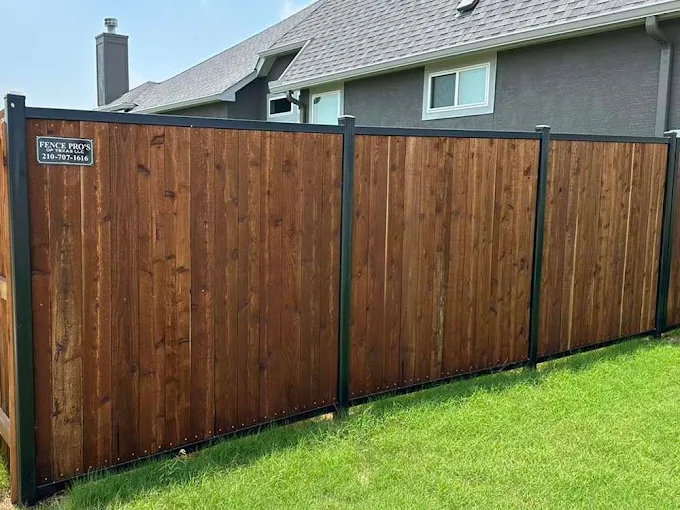
- Pressure-treated and cedar Wood Fences
Here’s a high-level comparison tailored to the Plano market:
| Material | Typical Use in Plano | Security Level | Privacy | Maintenance | Relative Cost (Plano) |
|---|---|---|---|---|---|
| Chain Link | Warehouses, utilities, storage yards | Medium–High | Low | Low | $ |
| Wrought Iron / Steel | Offices, retail, upscale properties | High | Low | Medium | $$$ |
| Aluminum | Offices, schools, HOA common areas | Medium | Low | Low | $$ |
| Corrugated / Solid Metal | Industrial, mixed-use, modern offices | High | High | Low | $$–$$$ |
| Vinyl / Composite | Daycares, medical, hospitality | Medium | High | Low | $$–$$$ |
| Wood | Restaurants, small offices, screening walls | Medium | High | Medium–High | $$ |
A manufacturing facility near President George Bush Turnpike opted for 8-foot chain link with privacy slats around the back lot and ornamental steel along the street frontage. That combination gave them heavy-duty security where they needed it, and a polished public-facing look that satisfied both the city and their corporate brand standards.
CALLOUT: You don’t have to choose just one material. Mixed solutions—like Mixed Material Fences or steel plus masonry—often deliver the best balance of cost, security, and curb appeal.
When you sit down with a commercial fence contractor, expect them to walk you through not just aesthetics, but also wind ratings, coating systems, and how each material holds up to North Texas heat, storms, and clay soil movement.
Security, Access Control, and Risk Management
For many Plano businesses, security is the driving force behind a new fence. The goal isn’t just to “have a fence”—it’s to manage risk and reduce exposure.
What Makes a Fence “Secure”?
A true Security Fence Installation considers:
- Height (often 7–8 feet for commercial perimeters)
- Anti-climb features (picket spacing, spear tops, or curved chain link)
- Visibility (clear lines for cameras and patrols)
- Integration with Commercial Fence Installation and gate systems
- Durability against cutting, prying, or ramming
A distribution center near Plano’s industrial corridor had recurring theft from their loading dock area. We replaced a low, aging wood fence with 8-foot chain link topped with barbed wire, tied into monitored access control gates. The result was a measurable drop in incidents and an easier time negotiating insurance terms.
“Security fencing is part of a layered defense—lighting, cameras, procedures, and training should all work together.” — Corporate Security Consultant
Integrating Gates and Access Control
For many properties, the gate is the weakest link. A strong perimeter fence paired with a flimsy or poorly designed gate leaves a clear vulnerability.
Consider:
- Slide vs. swing Commercial Gates for truck access
- Card readers, keypads, or remote access controls
- Safety loops and sensors to prevent vehicle damage
- Emergency access for fire and police per Plano codes
The right combination of fencing and gate automation not only protects your site but can also streamline operations—reducing bottlenecks at shift changes or delivery windows.
Balancing Privacy, Aesthetics, and Brand Image
Not every commercial fence is about high security. For many Plano businesses, privacy and appearance are just as critical—especially in customer-facing industries.
Where Privacy Matters Most
We see high demand for Privacy Fence Installation in:
- Medical and dental offices (HIPAA concerns and patient comfort)
- Restaurants and hospitality (patios, dumpsters, back-of-house)
- Multi-tenant offices and mixed-use developments
- Daycares and schools
A pediatric clinic near Preston Road wanted to create a calm outdoor play and waiting area shielded from traffic. A tall vinyl privacy fence with soft colors and integrated landscaping delivered the privacy they needed while staying low-maintenance and professional looking.
Designing for Curb Appeal
Your fence is often the first physical touchpoint for clients, tenants, and employees. Modern commercial design trends in Plano favor:
- Clean lines and Decorative Fence Installation using aluminum or ornamental steel
- Mixed Material Fences combining metal with masonry or wood accents
- Neutral colors that complement building façades
- Strategic use of glass or open designs in high-visibility storefronts
We recently worked with a professional services firm near Shops at Legacy that wanted to enclose a small courtyard. They chose a low-profile Glass Fences system with aluminum posts. It kept the area secure without blocking views or making the space feel closed off.
CALLOUT: A fence can quietly reinforce your brand—modern and sleek, traditional and stately, family-friendly, or highly secure. Treat it as a design element, not just a barrier.
Remember, Plano’s mix of corporate headquarters, retail, and residential means your property doesn’t exist in a vacuum. A fence that clashes with neighboring buildings or violates HOA or development guidelines can create friction you don’t need.
Durability, Maintenance, and Total Cost of Ownership
Upfront price is only part of the story. In North Texas, sun exposure, heat, wind, and shifting clay soils all take a toll on fences. The smartest commercial decision weighs installation cost against lifespan and maintenance.
How Materials Hold Up in Plano’s Climate
- Aluminum and Vinyl: Highly resistant to rust and rot; ideal for low-maintenance properties.
- Wrought Iron Fences and steel: Very strong, but require proper coatings and occasional touch-ups to prevent rust.
- Wood Fences: Attractive, but need regular staining or sealing, especially under intense summer sun.
- Corrugated Metal Fences: Durable and modern; with quality coatings, they offer long lifespans and minimal care.
A small office park near Coit Road originally went with basic wood screening to hide dumpsters and mechanical equipment. Within five years, sun and sprinkler exposure had warped and discolored much of the fence. They ultimately replaced it with a metal privacy system, which, while more expensive upfront, drastically reduced ongoing repair and staining costs.
Traditional vs. Long-Term Approach
| Approach | Pros | Cons | Best For |
|---|---|---|---|
| Lowest Upfront Cost | Quick savings, easy to approve | Higher repairs, shorter lifespan | Temporary sites, tight cash flow |
| Long-Term Investment | Lower lifetime cost, better performance | Higher initial capital outlay | Established businesses, owner-users |
We often walk Plano property managers through a 10–15 year cost comparison. In many cases, spending 20–30% more upfront on Aluminum Fence Installation or Vinyl Fence Installation saves significant money and hassle over time compared to cheaper wood or uncoated steel.
If you’re responsible for CAM charges in a commercial association, or you’re planning to hold the property long-term, that total cost of ownership calculation is essential.
Safety, Compliance, and Special Use Cases
Beyond security and aesthetics, your fence has to keep people safe and meet all applicable regulations. This is especially true for specialized areas like pools, playgrounds, and high-traffic zones.
Pools, Daycares, and Public Spaces
Texas and local codes have specific requirements for Pool Fence Installation, including:
- Minimum height
- Maximum spacing between pickets
- Gate self-closing and self-latching mechanisms
- Climb-resistant design
A Plano apartment community upgrading its amenities hired us to design a code-compliant pool enclosure that also fit their modern aesthetic. We installed an ornamental steel system with self-closing gates and integrated it with their access card system. The result: safer residents, easier inspections, and a more marketable property.
For daycares and schools, Garden Fence Installation and play area fences must:
- Prevent entrapment hazards
- Use safe, smooth surfaces (no sharp edges)
- Provide visibility for supervision
- Often combine privacy with child-safe features
“Code compliance isn’t optional; it’s your protection against liability and enforcement actions.” — Commercial Property Attorney
Industrial and Farm-Adjacent Properties
On the outskirts of Plano, we see a blend of commercial and agricultural needs. Some properties benefit from:
- Heavy-duty perimeter Farm Fencing for livestock or equipment
- Impact-resistant barriers near loading docks
- Clearly marked boundaries to separate public and operational areas
If your business operates near open land, pipelines, or utility easements, a consultation with a contractor who understands both commercial and farm fencing can prevent costly mistakes.
Planning, Design, and Working With a Local Expert
Even a straightforward Commercial Fence Installation involves more than digging post holes. A well-run project in Plano moves through clear stages:
1. Site Assessment & Goals
- Property lines, easements, and underground utilities
- Traffic patterns, access points, and visibility
- Security and privacy priorities
2. Custom Fence Design
- Material selection (e.g., Wrought Iron Fence Installation vs. chain link)
- Height, layout, gate placement
- Integration with existing structures, landscaping, and signage
3. Permits and Approvals
- City of Plano building and zoning requirements
- HOA or development guidelines (especially in master-planned areas)
- Coordination with tenants or neighboring properties
4. Installation and Quality Control
- Proper footings for clay soil conditions
- Alignment, tension, and hardware integrity
- Safety protocols during work (important for active sites)
5. Ongoing Care: Fence Repair and Maintenance
- Scheduled inspections
- Fast response for Fence Repair after storms or impacts
- Planning for Fence Replacement in aging sections
A medical office complex near Independence Parkway had multiple tenants, each with different expectations. We worked with the property manager to phase the project, maintain access during business hours, and coordinate design choices that satisfied everyone—from pediatric dentists to physical therapists.
CALLOUT: A local contractor who understands Plano’s codes, soil conditions, and development patterns can save you weeks of delays and unexpected costs.
What This Means for Businesses in Plano, TX
Plano’s business landscape is competitive and diverse. You have corporate headquarters, logistics hubs, medical offices, retail centers, and service businesses all sharing the same corridors. That variety makes a one-size-fits-all approach to fencing ineffective.
For your property, the right commercial fencing solution can:
- Reduce theft, vandalism, and unauthorized access
- Improve safety for staff, customers, and vendors
- Support insurance and risk management strategies
- Enhance curb appeal and reinforce your brand
- Keep you compliant with local codes and industry standards
Local realities matter. Plano’s clay soils demand proper post depth and concrete work. Summer storms and hail require durable materials and hardware. Development guidelines in areas like Legacy, Granite Park, or mixed-use zones affect your design options.
By approaching your fence as an integral part of your property strategy—not just an afterthought—you protect your investment, support your operations, and present a more professional face to your customers and partners.
Frequently Asked Questions
Q: How tall should my commercial fence be for adequate security in Plano?
A: For most commercial properties, a security-focused fence is at least 7–8 feet tall. Warehouses, storage yards, and logistics facilities often choose 8-foot Chain Link Fence Installation with or without barbed wire, depending on zoning and insurance requirements. Office and retail sites might opt for 6–7-foot Wrought Iron Fence Installation or aluminum to balance security with aesthetics. Plano’s codes and any overlay districts or HOAs may set maximum heights or additional rules, so it’s important to work with a local contractor who can confirm what’s allowed before you finalize your design.
Q: What’s the most cost-effective commercial fence material for my property?
A: “Cost-effective” depends on your time horizon. If you’re focused on upfront cost, chain link is usually the most economical for large perimeters. Over a 10–15 year period, though, Aluminum Fence Installation or Vinyl Fence Installation can be more cost-effective because they resist rust, rot, and frequent repainting. For properties with high privacy needs, Corrugated Metal Fences or composite systems can reduce long-term Fence Maintenance and Fence Repair costs. A good contractor will help you compare total cost of ownership, not just the initial bid.
Q: Can I mix different fence types on the same commercial property?
A: Yes, and it’s often the smartest approach. Many Plano businesses combine materials to match function and visibility. For example, you might use ornamental steel along the street-facing side for a polished look, and taller Privacy Fence Installation or chain link with slats around service yards or loading docks. We’ve installed Mixed Material Fences that pair metal frames with wood or composite infill to create a modern, durable solution. The key is thoughtful design so transitions look intentional and meet all code and security needs.
Q: How does commercial fencing affect my insurance and liability?
A: While every policy is different, insurers generally view strong perimeter controls as a positive risk factor. A properly designed Security Fence Installation with controlled access can reduce theft and vandalism claims, and may support better terms from your carrier. For properties with pools, play areas, or hazardous equipment, compliant Pool Fence Installation and safety barriers can also help limit liability. It’s wise to involve your insurance agent early, share your fence plans, and ensure the design supports any specific requirements they may have.
Q: What kind of maintenance should I expect for a commercial fence in Plano?
A: Maintenance depends on material. Wood Fences benefit from regular Fence Maintenance like staining or sealing every few years, especially under intense Texas sun. Metal systems—whether Aluminum Fences or Wrought Iron Fences—should be inspected annually for loose hardware, surface rust, or impact damage. Vinyl and composite fences mainly need occasional cleaning and hardware checks. For all systems, plan on periodic Fence Repair after major storms or accidental impacts from vehicles or equipment. A maintenance plan with a local contractor helps you catch small issues before they become expensive problems.
Q: How long does a typical commercial fence installation take?
A: Timelines vary based on project size, material availability, and permitting. A straightforward Commercial Fence Installation around a small office or retail site might take a few days once work begins. Larger perimeters around warehouses or business parks can take one to three weeks. In Plano, you also need to factor in time for design approvals, city permits, and any HOA or development reviews—often adding a few weeks to the front end. Working with an experienced local contractor helps streamline this process and minimize disruption to your operations.
Q: Do I need a custom design, or can I just choose a standard fence?
A: Standard panels work well for some applications, but many commercial properties benefit from Custom Fence Design. Irregular lot lines, grade changes, multiple access points, and branding requirements often call for a tailored approach. For example, integrating Residential Fence Installation aesthetics at the front of a mixed-use development while using more industrial solutions in the rear may require custom transitions. Custom doesn’t always mean expensive—it just means the layout, gate placement, and materials are chosen specifically for how your property functions day to day.
Ready to Get Started?
Commercial fencing isn’t something you want to rush—especially in a fast-growing, high-visibility market like Plano. At the same time, every month you delay can mean increased security risk, ongoing liability, or missed opportunities to elevate your property’s appearance.
Right now is an ideal time to plan your project. Cooler months are perfect for installation with less disruption from extreme heat, and many businesses schedule upgrades before peak leasing or busy seasons. Whether you’re securing a new warehouse, refreshing an aging perimeter, or adding controlled access to an existing site, starting the conversation early gives you more options and better pricing.
Your next step is simple: schedule a site assessment with a local expert. Walk the property, talk through your priorities, and explore specific options—from Fence Replacement to new installations and integrated gate systems.
Fence Pros of Texas can help you design and build a solution that fits your budget, supports your operations, and looks like it belongs in Plano’s modern commercial landscape.
About Fence Pros of Texas
Fence Pros of Texas is a locally focused fencing contractor serving Plano and the surrounding North Texas communities. Our team has years of experience designing and installing Residential Fence Installation, Commercial Fence Installation, and Farm Fencing solutions tailored to the region’s climate, soil, and building standards. From ornamental steel and aluminum to privacy systems, gates, railings, and staining services, we focus on durable craftsmanship and code-compliant design. To learn more about our services and see how we can support your next project, visit our website.