


San Antonio Texas’ Own Expert Fencing Contractors
Experience peace of mind with our local team of professional and knowledgeable fencing experts dedicated to delivering top-notch services.
With years of industry experience, our skilled team provides efficient installations, durable materials, and custom designs tailored to your needs. From residential to commercial projects, we prioritize precision, quality workmanship, and exceptional customer service every step of the way. Trust in our expertise and commitment to excellence for all your fencing needs.
Get in touch with our talented team to partner with top fencing professionals in the San Antonio Texas area. Let’s bring your fence goals to life!






YOUR FENCE YOUR CHOICE
CHOOSE YOUR PERFECT SOLUTION
Select an option below to get started on the perfect fence or gate for your home, business, or farm in the San Antonio Texas area.

Residential
Fencing
San Antonio Texas

Farm
Fencing
San Antonio Texas

Commercial
Fencing
San Antonio Texas

Custom
Gates
San Antonio Texas

I’m proud to have built Fence Pros of Texas based on a commitment to quality craftsmanship, customer satisfaction, and strong relationships.
Gus Hernandez
President Of Fence Pros of Texas
Get social
connect with us!
Follow us on social media for the latest updates, tips, and inspiration from Fence Pros of Texas. Stay connected with us for insights on fencing solutions, industry trends, and more.
Buying a fence in San Antonio texas
Our easy process
Our hassle-free fence-buying process begins with personalized guidance to select the perfect fence for your property. We take precise property measurements and assist in careful fence selection, leading to seamless delivery and installation for customer satisfaction and quality results.

Measure Your Property
Our simple fence buying process’s first step involves precise measurements of your San Antonio Texas property to ensure accurate planning and tailored fencing solutions to meet your needs and preferences.

Select a Fence Style
In the second step of our simple fence buying process, choose a fence style that suits your property needs. We will guide you through our selection of fences to find the perfect fencing style for your needs.

Delivery and Installation
During the final step of our effortless fence buying process, we ensure seamless delivery and expert installation of your chosen fence. Our professional team handles every detail with precision, ensuring a smooth experience.
We have been installing fences in San Antonio Texas since 2014.
Since then, we have established ourselves as one of the most reliable, most trusted fencing contractors in the entire San Antonio Texas area.
We meet all licensing and insurance requirements for each municipality where we install fences in San Antonio Texas.
Each municipality has different requirements for contractors, so feel free to speak with us directly about the requirements for your town. We will be happy to provide proof of insurance and licensure information.
This is an excellent thing to do when hiring any contractor, not just a fencing contractor. Unfortunately, there are a large number of unlicensed and uninsured contractors doing work across San Antonio Texas. Many homeowners and business owners don’t understand the risk they are taking by hiring such a company.
Absolutely! As one of the most trusted fencing contractors in the entire San Antonio Texas area, we stand behind our work.
Warranty on Fence Materials
We use professional grade materials and work with high-quality fence manufacturers. This means you are protected with excellent manufacturer warranties on all fencing materials (in most cases). Each fence type and fence manufacturer is different. Our fence experts will guide you to the best solution for your situation – making sure you receive the maximum protection and peace-of-mind for your fence!
Workmanship Warranty on Fence Installations
Our installers are expertly trained for all types of fencing. We are experienced with the specific soil conditions and other factors that impact the strength and resilience of fences installed in the San Antonio Texas area. We stand behind our work and offer a workmanship warranty on all residential and commercial fences we install. Please talk to our fence experts to get the full details of the workmanship warranty for your specific project, and feel confident that working with Fence Pros of Texas means you never have to worry about our quality or our support!
Yes!
Unfortunately, we hear horror stories all the time about local fence companies that don’t return phone calls after collecting a deposit or taking much longer to finish a fence than what they originally told the customer.
Please be careful when choosing a fence company in San Antonio Texas. There are many poorly run, unprofessional companies out there, and there are even a few that seem to be intentionally scamming people.
Our reputation across San Antonio Texas is excellent – because we work hard, we do what we say we’re going to do, and we stand behind our work. You can count on the fence experts at Fence Pros of Texas.
Prices on fences are highly dependent on the type of fence you choose and the amount of fencing you need as well as the exact style, height, and options you select.
We provide fencing quotes for free! Simply reach out to our team through our online form or give us a call and our team of friendly, experienced staff will be glad to walk you through the process and plan a consultation.
For your convenience, this is a very general guide to how the different types of fencing stack up to each other in terms of pricing:
Aluminum Fence
Expensive initial investment. However, because these fences require no maintenance and usually come with a lifetime warranty – over time, these fences can often provide the best value. There is also some evidence that aluminum fences have the most positive impact on the resale value of a home, if you ever choose to move.
Chain Link Fence
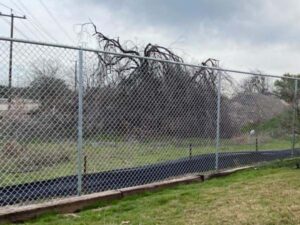
Chain link fencing is very common across San Antonio Texas because it is so versatile and so affordable as compared to just about every other fencing option. Adding upgrades and options will increase the cost of the fence to be more comparable to other types, but it’s usually still the lowest priced option.
Wrought Iron Fences
Wrought iron fencing is one of the more costly types of fencing in the San Antonio Texas region due to the weight and strength of the metal and the craftsmanship it takes to build. When you are in the market for a new fence, speak to our fence professionals who can help you get a quote for whichever types of fencing you’re looking for and help you find the perfect fit for your goals and your budget.
Vinyl Fence
Once a very expensive option, standard styles and colors of vinyl fencing may actually be cheaper than other options! Together with impressive warranties, long lifespans, and low-maintenance costs – vinyl fences are a great solution for many different situations.
Wood Fences
The cost of wood has increased tremendously in recent years, so it’s hard to make a general statement about how wood stacks up to the cost of the other types of fencing materials. While it does tend to be lower in price than the other options, the cost gap has definitely shrunk. It is also worth noting that there are real costs to treating, cleaning, and maintaining a wood fence over time.
We are asked this question all the time. The truth is that aluminum fences, chain link fences, ornamental steel fences, vinyl fences and wood fences, are all very popular choices in San Antonio Texas.
What we can tell you is the most popular style of each type of fencing:
3-Rail Black Aluminum Fence
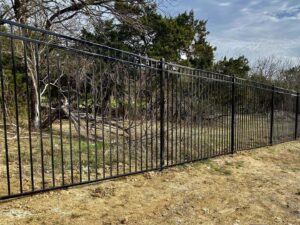
This is the workhorse of aluminum fencing. Used for both residential and commercial applications, people all across San Antonio Texas choose this aluminum fence style for perimeter fencing around their yard, to protect pools, for decorative applications, and more.
Vinyl Coated Chain Link Fence
Chain link fencing protected by PVC (or vinyl) colored coating looks great and lasts a very long time! No matter where you go in San Antonio Texas these chain link fences are everywhere!
Standard Wood Privacy Fence
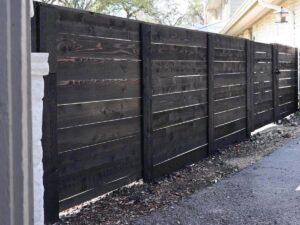
The standard 6 ft. wood privacy fence is the style of fence that literally represents the entire industry. For many people, when you close your eyes and imagine a “normal fence” this is the image that many people across San Antonio Texas see.
Standard 6 ft. White Vinyl Privacy Fence
Similar in style, design, and purpose to the standard wood privacy fence, the white vinyl version adds the additional benefit of coming with a strong warranty and is maintenance free! It’s no wonder so many people across San Antonio Texas choose the standard white vinyl privacy fence.
While we install fences across nearly every corner of San Antonio Texas, we do understand that many homeowners and business owners want to know a little more about our experience and reputation in their specific town. No problem! Let’s do this!
Below are the top areas in San Antonio Texas where we install residential and commercial fences:
Shavano Park Texas Fence Contractor
We install a whole lot of fences in Shavano Park Texas for your friends and neighbors. We are fully licensed and insured to install all types of fencing in Shavano Park Texas
Leon Valley Texas Fencing Contractor
We are one of the leading fence companies serving Leon Valley Texas since 2014.
Helotes Texas Fence Company
We are one of the most trusted fence contractors in Helotes Texas for both residential fences and commercial fences.
Castroville Texas Fencing Company
Homeowners and business owners in Castroville Texas trust Fence Pros of Texas for professional fence installation services and one of the best fence warranties in the area.
Selma Texas Fence Installation Services
We have installed just about every type of fence imaginable in Selma Texas since 2014.
Converse Texas Fence Installation and Repair
More Converse Texas property owners trust Fence Pros of Texas to install their residential and commercial fences than just about any other fence company in the area.
For the full list and a more detailed description of each of the areas we serve, check out our complete Service Area .
Common
Questions
Let our team at Fence Pros of Texas answer some of your most frequently asked questions!




YOUR fence project
taking action
Choose from our options below to begin creating the fence you’ve envisioned.
Let’s turn your dream fence into a reality!